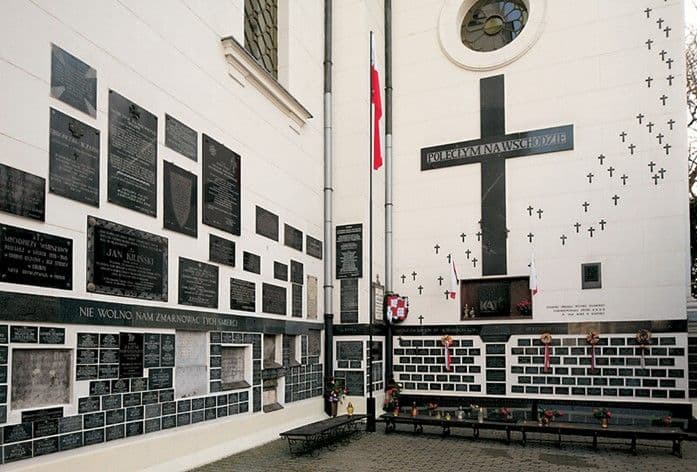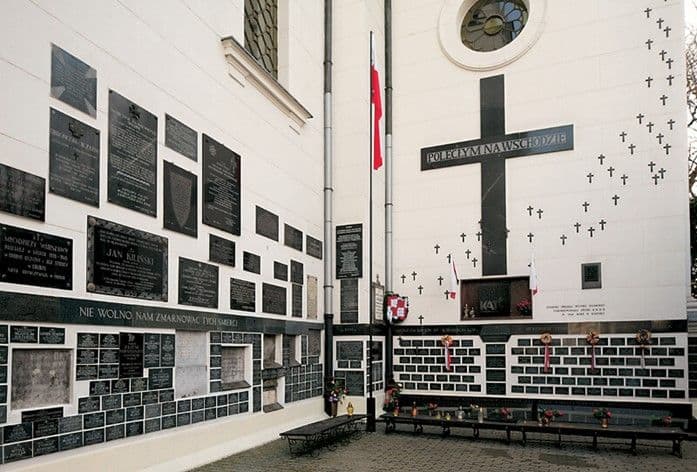
The origins of the parish of St. Charles Borromeo in Warsaw's Wola district date back to the late 18th century. The construction of the church is connected with the abduction of King Stanisław August Poniatowski by the Bar Confederates on 3 November 1771 and his removal beyond the city limits. Since the very next day, near Powązki, on the feast of St. Charles Borromeo, the king—left alone with his captor, Jan Kuźma—persuaded him to set him free, this event was commemorated appropriately.
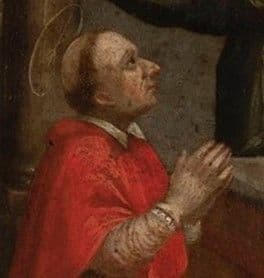
When a cemetery for the parishes of St. John, the Blessed Virgin Mary and St. Andrew was established beyond the Powązki toll gates, construction was already under way on a church in its eastern section, midway along the longer side. The church was funded by King Stanisław August Poniatowski and his brother, Primate Michał Poniatowski, and designed by the royal architect Dominik Merlini. The cornerstone was blessed on 20 May 1792, and the church was consecrated on 21 October. The first house of worship was a single-nave building without a basement. Since it also served as a mortuary, there were no windows in the south façade, in order to keep the interior cool. Two sacristies stood south of the chancel. The plastered interior was covered by a wooden ceiling, the floor was wooden, and pillars supported the choir beneath the north window. The modest altars were dedicated to the patron saints of the individual parishes. On the collegiate church's altar hung a painting by Józef Wall depicting St. Charles Borromeo at prayer, donated by the primate. The church was renovated in 1820 and 1837; during this period it acquired a painting of the Assumption of the Blessed Virgin Mary by Józefat Łukaszewicz. In 1844–1846, Mielicie Chiarini painted the vault.
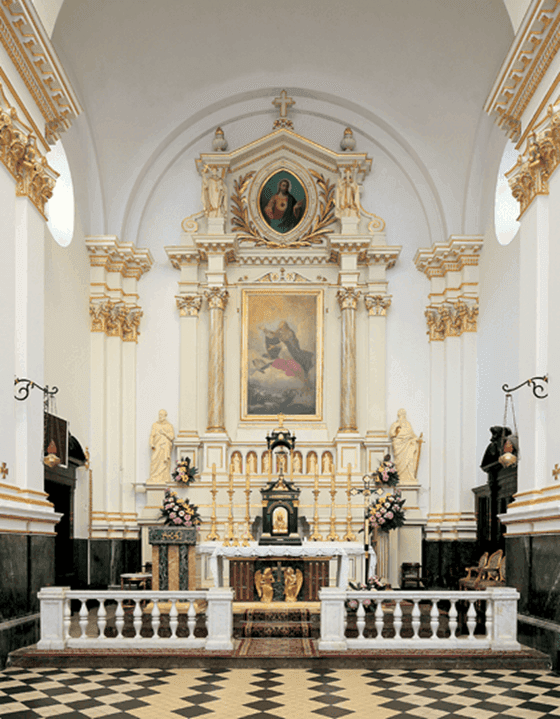
By the end of the 19th century, the church had once again become too small. It was clear that the Russian authorities, who were generally hostile to the Catholic Church, would not approve the construction of a new church. Under the pretext of an expansion, a new church was built between 1891 and 1898 according to plans by architect Józef Pius Dziekoński. Only the façade and parts of the side walls of the old building remained. The new three-nave church was built on a Latin cross plan, with a dome on a high drum above the crossing of the main nave and transept, a chancel ending in a semicircular apse, a sacristy, and two bell towers flanking the façade, which was crowned by a tympanum with a figure of an angel calling the faithful to the Last Judgment. Of the planned three levels of crypts, two were completed; these became catacombs where benefactors of the church and remains transferred from graves destroyed during the expansion were laid to rest. The result was a building six times larger than its predecessor, approached by a double staircase with a balustrade bearing a statue of Our Lady of Grace by Teodor Skonieczny. Inside, the old wooden altars were replaced by new stone ones designed by Dziekoński, though the existing paintings were retained. In the semicircular apse of the chancel stood the main altar, with a painting of St. Charles Borromeo by Józef Wall in the altarpiece and a painting of Jesus with His Sacred Heart by Rafał Radziewicz in the crown, adorned with figures of St. Peter and St. Paul. The arms of the transept were closed by side altars: one dedicated to St. Joseph, with a titular painting by Alfred Schouppe flanked by angel figures; the other dedicated to the Assumption of the Blessed Virgin Mary, with its titular painting in the central panel, a small painting of the Holy Trinity above it, and figures of St. Casimir and St. Stanislaus Kostka on either side. At the crossing of the main nave and transept, to the left of the main altar, stood a carved pulpit made of almost black wood, with a historic crucifix opposite it. In 1900, the church was blessed and officially handed over to the faithful. The vault was decorated with polychrome painting by an unknown artist. In 1913, Zdzisław Piotr Jasiński painted the figures of the Evangelists in the pendentives beneath the dome's drum.